
Opinion
Bayo Onanuga’s Revisionist History Cannot Erase the Questions That Still Haunt 2023 Election – By Maazi Tochukwu Ezeoke

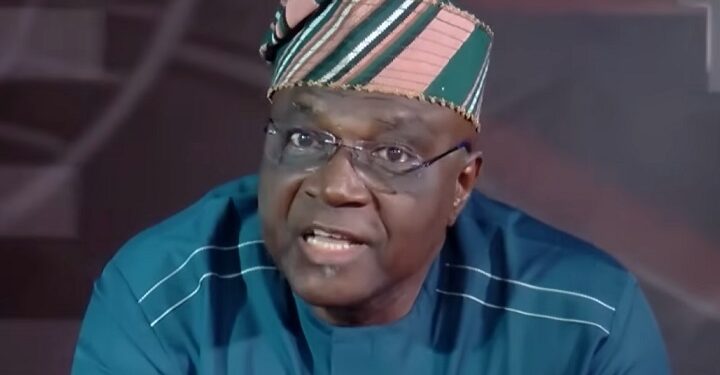
Peter Obi Is Asking for Electoral Integrity, Not Political Favour.
Bayo Onanuga’s latest broadside against Peter Obi is not an exercise in political analysis. It is an exercise in political revisionism.
Rather than engage the substance of Obi’s interview on Channels Television, the Presidential spokesman resorts to familiar talking points, branding Obi a “political nomad” while carefully sidestepping the questions that continue to trouble millions of Nigerians about the integrity of the 2023 presidential election.
At the heart of this debate is a simple truth Mr Onanuga deliberately ignores. Peter Obi is not asking anyone to hand him power. He is demanding what every democracy worthy of the name must guarantee, elections that are free, fair, transparent and verifiable. That is not a partisan demand. It is the foundation of democratic legitimacy.
Onanuga’s attempt to portray Obi as uniquely opportunistic collapses under even the most basic examination of Nigeria’s political history.
President Bola Tinubu’s own political journey passed through the SDP, Alliance for Democracy, Action Congress, Action Congress of Nigeria and eventually the APC, itself a coalition forged through the merger of several parties.
When the AD became politically unsustainable, Tinubu helped build new political platforms to advance his political ambition. That decision has been celebrated as strategic leadership.
Maazị Tochukwu Ezeoke, Ichie Onye Njenje
Maazị Tochukwu Ezeoke, Ichie Onye Njenje
Why then should Peter Obi’s movement from APGA to the PDP, Labour Party, ADC and now the NDC be presented as evidence of political instability?
Nigerian political parties have rarely been ideological institutions.
They have largely functioned as electoral vehicles, with politicians across every major party changing platforms in response to internal crises, mergers and shifting political realities. To applaud one politician’s realignment as visionary while condemning another’s as opportunistic is not consistency. It is hypocrisy.
More importantly, Mr Onanuga deliberately ignores the political context surrounding Obi’s recent movements. It has been widely alleged by opposition figures that the prolonged crises within the Labour Party and the ADC did not arise in isolation but were fuelled by external interference designed to weaken the opposition and frustrate Peter Obi’s participation in the 2027 presidential election.
Whether those allegations are ultimately proved or disproved, they deserve serious engagement, not dismissal. Instead of addressing those concerns, Mr Onanuga reduces a complex political reality to a simplistic narrative of personal ambition.
More revealing than what Onanuga wrote is what he refused to address.
Despite devoting thousands of words to attacking Obi’s political journey, he completely ignored the issue that continues to trouble millions of Nigerians.
Why did INEC’s much-publicised Result Viewing Portal, IReV, fail when Nigerians were repeatedly assured it would deliver unprecedented transparency in the presidential election?
That failure became one of the defining controversies of the 2023 election. While the courts ultimately upheld the declared outcome, the legal conclusion did not answer the broader democratic questions. A judicial verdict determines the legality of an election. It cannot, by itself, restore public confidence where transparency has been called into question.
Mr Onanuga owes Nigerians answers, not insults.
Why did the transparency mechanism fail when transparency mattered most?
Who will explain the controversies surrounding the collation of results and the allegations of discrepancies in Rivers, Lagos and several other states?
Who bears responsibility for the widespread loss of public confidence in an electoral process that Nigerians were assured would be the most technologically transparent in the country’s history?
These are legitimate democratic questions. They are not acts of rebellion.
Equally misleading is Onanuga’s attempt to reduce Obi’s 2023 performance to ethnic voting. Electoral facts tell a different story. Obi won in Lagos and the Federal Capital Territory, two of Nigeria’s most cosmopolitan jurisdictions, while attracting millions of young Nigerians, professionals, first-time voters and citizens from every region who were united not by ethnicity but by a shared desire for competent leadership and accountable government.
Reducing that movement to ethnic sentiment is intellectually dishonest and politically lazy.
Nor does Onanuga acknowledge Obi’s record in public office. As Governor of Anambra State, he earned a reputation for fiscal discipline, prudent financial management and sustained investment in education, healthcare and infrastructure. His record is open to public scrutiny and should be debated honestly, not buried beneath partisan rhetoric.
Ultimately, this debate is bigger than Peter Obi or Bola Tinubu. It is about the integrity of Nigeria’s democracy. It is about whether future elections will inspire confidence rather than suspicion. It is about whether institutions will serve the Constitution or those who temporarily occupy public office.
Mr Onanuga would better serve the country by explaining why IReV failed when Nigerians needed it most, addressing the lingering controversies surrounding the collation of results in key states, and outlining the concrete reforms that will guarantee future elections are beyond reproach.
History does not judge governments merely by the elections they win. It judges them by the institutions they strengthen and the confidence they inspire.
Peter Obi has consistently argued for one principle, that every lawful vote should count, every result should be transparently verifiable, and every Nigerian should have absolute confidence in the electoral process.
That is not the language of a sore loser.
It is the language of a democrat.
Written by Maazi Tochukwu Ezeoke
Headmaster, Village Boys Movement (VBM).

